
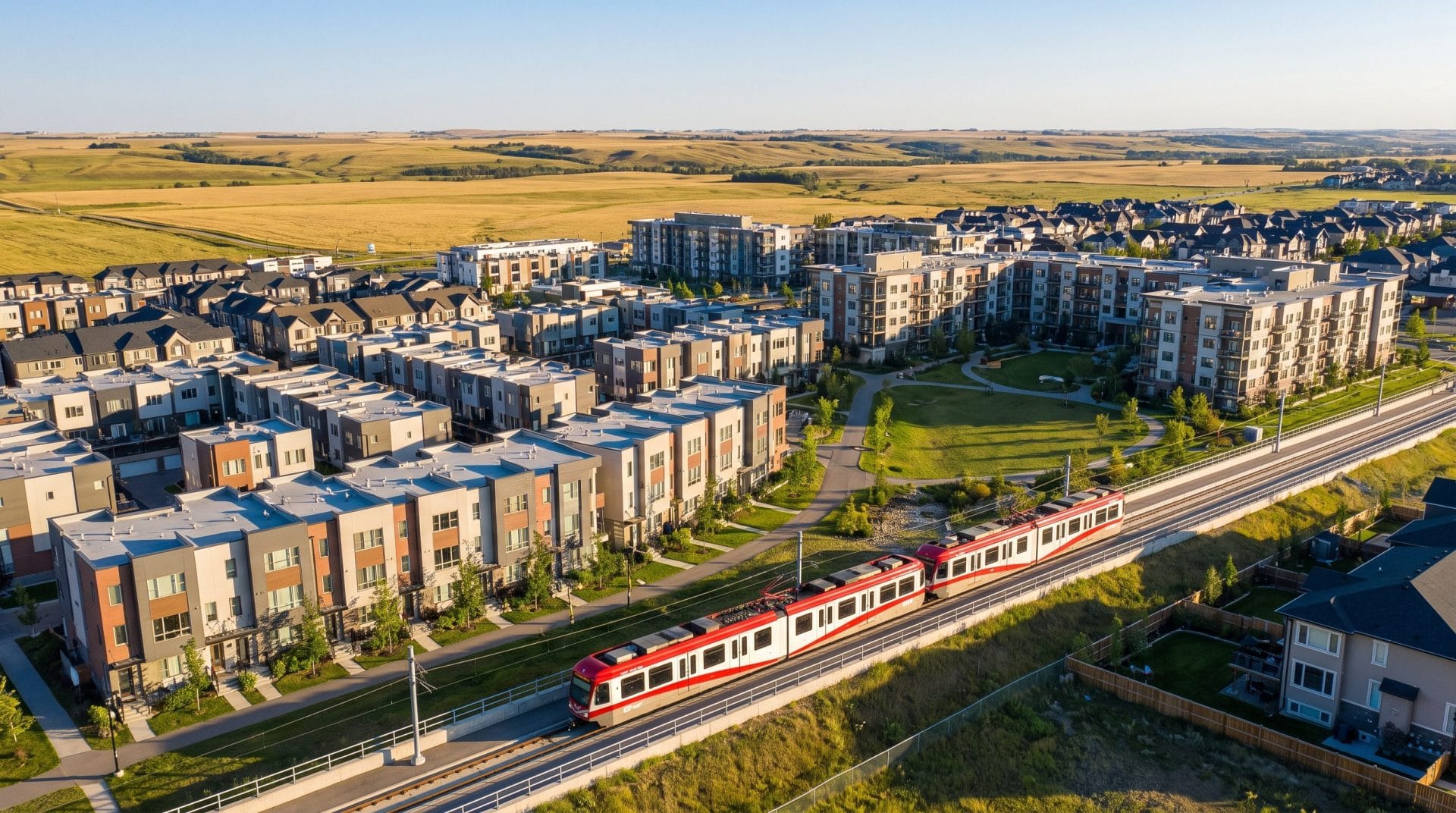
Transit-Friendly Communities in Calgary 2026: Where to Live for Car-Free Convenience
If you are searching for a home in Calgary where you can ditch the car keys, you are not alone. More buyers than ever are prioritizing CTrain access, walkability, and transit-oriented development when choosing where to live. Calgary’s LRT network spans 59.9 kilometres across two lines, connecting downtown to the city’s fastest-growing suburbs and creating pockets of genuine car-free living in the process.
As a Calgary real estate agent who has helped dozens of families settle into transit-accessible neighbourhoods, I have seen firsthand how the right location can transform your daily commute, reduce your transportation costs, and improve your quality of life. Whether you are a young professional tired of gridlock, a retiree looking to simplify your routine, or a family trying to cut down on vehicle expenses, this guide will walk you through Calgary’s best transit-friendly communities in 2026.
Why Transit-Friendly Neighbourhoods Are Outperforming in 2026
Calgary’s real estate market in 2026 tells a clear story: homes near LRT stations consistently sell faster and at a premium compared to car-dependent suburbs. According to the Calgary Real Estate Board (CREB), properties within 800 metres of a CTrain station saw average price increases of 4.2% year-over-year, compared to 2.8% for homes more than two kilometres from transit.
Several factors are driving this trend. Transportation costs have risen sharply, with the average Calgary household spending over $12,000 annually on vehicle ownership, insurance, fuel, and maintenance. A household that can replace one car with a transit pass saves roughly $7,000 to $9,000 per year. That is a significant amount that can be redirected toward mortgage payments, savings, or lifestyle spending.
The City of Calgary’s Transit-Oriented Development (TOD) strategy has also played a major role. Since 2020, the city has approved over 4,500 new housing units within 400 metres of LRT stations, with a mix of mid-rise apartments, townhouses, and mixed-use developments. This density creates vibrant, walkable communities where daily errands, restaurants, and services are all within easy reach.
For buyers considering Calgary’s best neighbourhoods to buy a home in 2026, transit access should be near the top of your checklist. It affects not just your daily convenience but also your home’s long-term resale value and rental appeal.
Beltline: Calgary’s Most Walkable Urban Neighbourhood
If walkability and transit access are your top priorities, Beltline is hard to beat. Located directly south of downtown, this neighbourhood is served by Victoria Park/Stampede Station, City Hall Station, and Erlton/Stampeded Station on the Red Line, with several bus routes connecting to every corner of the city.
Beltline’s Walk Score consistently ranks above 90, placing it in the “Walker’s Paradise” category. Grocery stores, restaurants, pharmacies, parks, and fitness centres are all within a five-minute walk. The neighbourhood’s 12th Avenue and 4th Street corridors offer some of Calgary’s best dining and shopping, all accessible without a car.
What to expect in Beltline:
- Average home price (2026): $485,000 for condos, $720,000 for townhouses – Walk Score: 92/100 – Transit Score: 88/100 – Average commute to downtown: 8 minutes by CTrain, 12 minutes by bike – Neighbourhood density: High-rise and mid-rise mixed-use
Beltline appeals primarily to young professionals, downsizers, and investors. The rental market is strong, with vacancy rates hovering around 3.1% according to CMHC’s 2026 Rental Market Report. If you are looking for an investment property that attracts quality tenants, Beltline’s combination of transit access and lifestyle amenities makes it a solid choice.
The main trade-off is price. Beltline real estate commands a premium, and parking is limited in most buildings. For buyers who genuinely want to live car-free, this is actually an advantage — it forces the lifestyle you are aiming for.
Tuscany and Crowfoot: Northwest Living with Red Line Access
Moving to the northwest quadrant, Tuscany offers a compelling blend of suburban comfort and genuine transit connectivity. Served by Tuscany Station — the northern terminus of the Red Line — this neighbourhood provides a direct 22-minute ride to downtown Calgary with trains running every 10 minutes during peak hours.
Crowfoot Station, located just south of Tuscany, adds even more convenience with the adjacent Crowfoot Centre, one of Calgary’s largest shopping destinations. Residents can catch the train, grab groceries, and head home without ever starting their engine.
Tuscany highlights for transit-oriented buyers:
- Average home price (2026): $520,000 for single-family homes, $380,000 for townhouses – Walk Score: 65/100 (moderate — daily errands possible with a short walk to Tuscany Station) – Transit Score: 78/100 – Average commute to downtown: 22 minutes by CTrain – Family-friendly: Yes, with excellent schools and parks
Tuscany is particularly attractive for families who want suburban space without sacrificing transit access. The neighbourhood has multiple schools within walking distance, including Tuscany School (K-4) and Eric Harvie School (K-9), both part of the Calgary Board of Education. The Calgary Catholic School District also operates nearby options.
For families exploring the surrounding area, 12 towns near Calgary offer excellent suburban options, but Tuscany’s direct LRT connection to downtown gives it a distinct advantage over communities that rely solely on bus routes or car commuting.
Brentwood and University: Established Neighbourbours with Strong Transit
Brentwood Station, also on the Red Line, serves one of Calgary’s most established northwest neighbourhoods. With the University of Calgary, Southern Alberta Institute of Technology (SAIT), and University of Calgary Research Park all nearby, this area has long been a hub for students, academics, and professionals.
The neighbourhood’s mature tree-lined streets, established parks, and proximity to Nose Hill Park give it a distinctly suburban feel while maintaining excellent transit connectivity. Brentwood Centre provides everyday shopping needs, and the Brentwood Village shopping area has seen significant revitalization in recent years.
Brentwood at a glance:
- Average home price (2026): $560,000 for single-family homes, $340,000 for condos – Walk Score: 71/100 – Transit Score: 82/100 – Average commute to downtown: 18 minutes by CTrain – Rental demand: Very strong, driven by university students and young professionals
One of Brentwood’s hidden advantages is its proximity to the University of Calgary campus, which is accessible via a single CTrain stop or a 15-minute walk. For families with children planning for post-secondary education, this proximity can save thousands in future housing costs.
The neighbourhood also benefits from the Fraser Institute’s ranked schools in the area, including Senator Patrick Burns Junior High and William Aberhart High School, both well-regarded for academic performance.
Saddletowne and Martindale: Southeast Growth with Blue Line Access
Calgary’s Blue Line connects the northeast and southeast quadrants, and Saddletowne Station serves as the eastern terminus. Saddletowne has emerged as one of Calgary’s most affordable transit-friendly neighbourhoods, with a diverse community, strong cultural amenities, and a brand-new regional recreation centre.
Martindale, located just north of Saddletowne, offers newer housing stock and family-friendly street layouts. Both neighbourhoods are served by Saddletowne Station, which provides a 25-minute ride to downtown with connections to the Red Line at City Hall Station.
Saddletowne and Martindale overview:
- Average home price (2026): $410,000 for single-family homes, $290,000 for townhouses – Walk Score: 58/100 (developing — new commercial areas growing near the station) – Transit Score: 75/100 – Average commute to downtown: 25 minutes by CTrain – Cultural diversity: High — one of Calgary’s most multicultural neighbourhoods
For budget-conscious buyers who still want reliable transit access, Saddletowne and Martindale offer exceptional value. The price gap between these neighbourhoods and comparable homes in the northwest can exceed $150,000, freeing up significant funds for other priorities.
The Saddletowne Hub, a community centre that opened in 2023, includes a library, gymnasium, and multipurpose rooms. New commercial development around the station is gradually improving walkability, with more shops and restaurants expected to open in 2026 and 2027 as the area continues to densify.
Downtown and East Village: The Original Transit Hub
No discussion of transit-friendly living in Calgary is complete without mentioning downtown itself. East Village, situated at the junction of the Red and Blue Lines, has undergone a remarkable transformation over the past decade. What was once a neglected industrial area is now one of Calgary’s most vibrant urban neighbourhoods.
East Village residents enjoy access to both CTrain lines, the downtown cycling network, and the Riverwalk pathway along the Bow River. The neighbourhood is home to the National Music Centre, Central Library, and a growing number of restaurants and boutiques.
East Village highlights:
- Average home price (2026): $440,000 for condos – Walk Score: 95/100 – Transit Score: 95/100 – Average commute to downtown: Walking distance or 5 minutes by CTrain – Lifestyle: Urban, walkable, culturally rich
East Village is ideal for buyers who want the full urban experience with minimal car dependency. The trade-off is primarily space — most housing is condominium-based, and square footage comes at a premium. However, for singles, couples, or downsizers, the convenience factor is unmatched.
How to Evaluate Transit Access When Buying a Home
When assessing a neighbourhood’s transit-friendliness, I recommend my clients consider several practical factors beyond just proximity to an LRT station.
Key evaluation criteria:
- Walk time to nearest station: Aim for under 10 minutes (800 metres or less) – Service frequency: Check peak-hour train intervals — 10 minutes or less is ideal – Line connectivity: Red Line and Blue Line offer the most coverage; check if transfers are needed – Last-mile options: Look for bike lanes, bus connections, or walkable destinations near the station – Future transit plans: Review the City of Calgary’s RouteAhead plan for planned LRT extensions and new stations – Parking availability: If you plan to keep a car, check if your building or street has adequate parking
Calgary Transit’s fare structure in 2026 offers a monthly pass at $116 for unlimited travel on both CTrain and bus routes. Compared to the cost of downtown parking alone ($200-$350 per month), a transit pass represents significant savings for downtown commuters.
For buyers relocating from other provinces, it is worth noting that Calgary’s transit system is consistently ranked among Canada’s top 10 for reliability and coverage. The city’s commitment to expanding the LRT network, including the Green Line (currently in pre-construction), means that transit-friendly neighbourhoods are likely to become even more connected in the coming decade.
Comparing Transit-Friendly Neighbourhoods: A Buyer’s Matrix
Choosing the right transit-friendly community depends on your budget, lifestyle preferences, and commute patterns. Here is a quick comparison to help you narrow down your search.
Budget tier (under $450,000): Saddletowne, Martindale, and select condo developments in East Village offer the most affordable entry points into transit-oriented living.
Mid-range tier ($450,000-$600,000): Beltline condos, Brentwood, and Tusconey provide a balance of space, amenities, and transit access. This range offers the most options for families.
Premium tier ($600,000+): Beltline townhouses, luxury condos in East Village, and established homes near Brentwood Station command top prices for the combination of location and convenience.
Each of these neighbourhoods offers a different lifestyle, but they all share one critical advantage: reduced car dependency. That translates into lower transportation costs, less stress from commuting, and a smaller environmental footprint.
If you are in the early stages of your home search, I recommend reviewing our Calgary Communities Guide for a broader overview of what each area offers. And if you are relocating from out of town, our moving checklist will help you plan a smooth transition to Calgary.
Frequently Asked Questions
What is the best CTrain station area for families in Calgary?
For families, Tuscany and Brentwood stand out as the best CTrain station areas. Both offer single-family homes, excellent schools, parks, and direct LRT access to downtown. Tuscany has a slight edge for newer construction, while Brentwood offers more established neighbourhoods with mature landscaping.
How much can I save by living near the LRT in Calgary?
A household that eliminates one car can save between $7,000 and $9,000 annually on vehicle payments, insurance, fuel, and maintenance. Even reducing to one car instead of two represents significant savings over the life of a mortgage.
Is the Green Line LRT going to change which neighbourhoods are transit-friendly?
Yes. The Green Line will add 18 new stations across Calgary, connecting communities in the north and southeast that currently lack LRT service. Areas along the planned corridor — including North Pointe, Douglasdale, and Ogden — will see significant improvements in transit access once the line is operational.
Are condos near LRT stations good investments?
Historically, yes. Condos within 800 metres of CTrain stations have appreciated at a faster rate than comparable units farther from transit. Rental demand is also stronger, with lower vacancy rates and higher rental yields. However, location quality, building management, and unit specifics still matter significantly.
What Walk Score should I look for when buying a home in Calgary?
A Walk Score of 70 or above is considered “very walkable” and means most errands can be accomplished on foot. Scores above 90 indicate a “Walker’s Paradise” where daily life does not require a car. For transit-oriented living, I recommend targeting neighbourhoods with both a Walk Score above 65 and a Transit Score above 75.
Ready to Find Your Perfect Transit-Friendly Home?
Calgary’s transit network is expanding, and the neighbourhoods along its lines offer some of the best value and lifestyle combinations in the city. Whether you are drawn to Beltline’s urban energy, Tuscany’s family-friendly streets, or Saddletowne’s affordability, there is a transit-connected community that fits your needs and budget.
Ready to explore homes for sale near Calgary’s CTrain stations? Contact me today for a personalized neighbourhood tour and help finding your ideal transit-friendly home. I will match your commute needs, budget, and lifestyle preferences to the perfect community.
Get in touch with Sanket Patel, REALTOR®
📞 403-918-7080
🌐 www.patelsanket.ca
📍 820 26 St NE, Calgary, AB T2A 2M4